
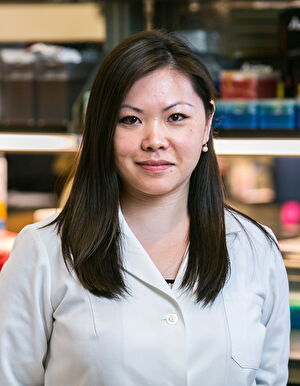
Dr. Wong’s research career has been dedicated to studying pathophysiological mechanisms underlying central nervous system injury (CNS) injury and disorders, with the goal of identifying therapeutic targets to promote CNS regeneration and repair. Dr. Wong received her Ph.D. in Biological Sciences, and B.S. in Neurobiology from the Neurobiology and Behavior Department at University of California, Irvine. Her thesis work focused on evaluating the impact of plasticity-promoting drugs and motor training on locomotor recovery following spinal cord injury. Dr. Wong completed a postdoctoral fellowship at Icahn School of Medicine at Mount Sinai in New York, where she investigated molecular signaling pathways and epigenetic mechanisms which can be manipulated to improve ischemic injury following stroke, and enhance axon regeneration following spinal cord injury.
In 2015, Dr. Wong became a principal investigator at Tisch MSRCNY, where she oversees the Experimental Research Center. She has used her surgical expertise to develop the first animal model for primary progressive MS (PPMS) via intrathecal injection of PPMS patient cerebrospinal fluid (CSF) into the cervical spinal cord subarachnoid space in mice. This PPMS animal model exhibits hallmark MS pathology including: demyelination, reactive astrogliosis and axonal damage, which consistently manifests as forelimb motor deficits. In a landmark publication, Dr. Wong reported that pathogenic antibodies in CSF are a distinctive feature of PPMS. Using her animal model, Dr. Wong and her team discovered that only PPMS CSF or recombinant antibodies (rAbs) derived from B cells in PPMS CSF induced motor disability and hallmark MS pathology in the cervical spinal cord, the region that is predominantly affected in PPMS patients. This was not observed with CSF or rAbs from relapsing-remitting MS (RRMS) or secondary progressive MS (SPMS) patients.
Dr. Wong has also used the same surgical approach to develop a specific animal model for sporadic amyotrophic lateral sclerosis (sALS), a previously unmet need. ALS is a fatal neurodegenerative disease characterized by motor neuron degeneration. In 90% of ALS patients, the disease arises sporadically with unknown cause, while only 10% develop familial ALS (fALS) due to inherited gene mutations. Dr. Wong and her team discovered that CSF from sALS patients, but not fALS patients, induced hallmark ALS pathology including upper and lower motor neuron degeneration and cytoplasmic TDP-43 translocation, resulting in motor disability. Dr. Wong reported the identification of apolipoprotein B-100 (ApoB) as the neurotoxic factor in sALS CSF responsible for inducing motor disability and motor neuron degeneration, using a series of CSF filtration studies and proteomic analysis.
In both PPMS and sALS studies, Dr. Wong and her team have demonstrated that CSF filtration can successfully remove pathogenic or neurotoxic factors from CSF, which subsequently attenuates the pathogenic capacity of CSF to induce clinical symptoms and disease pathology. Dr. Wong is a member of the NeurapheresisTM Research Consortium, which is geared towards advancing the use of CSF filtration therapy in various neurological conditions.
Active ongoing projects in Dr. Wong’s team include: 1) elucidating mechanisms underlying antibody-mediated pathology in PPMS, 2) understanding how elevated ApoB and cholesterol dysregulation leads to motor neuron degeneration in sALS, 3) testing potential therapeutics in animal models of PPMS and sALS, 4) investigating why RRMS patients transition to SPMS, and 5) understanding cerebellar dysfunction in MS.